If you’ve ever tried to work out whether you’re required to use winter tires, you’ve probably noticed that the answer depends a great deal on where you live and where you’re driving. Winter tire laws in Canada vary from province to province, and in the US the rules are set state by state, often with a focus on mountain routes. This guide brings the main requirements together in one place, so it’s easier to know what applies to your trip or your commute.
Winter Tire Laws in Canada: Quebec
Quebec has the clearest province-wide rule in the country. From December 1 to March 15 passenger vehicles registered in Quebec must be equipped with four winter tires that meet the province’s standards, which means tires carrying the mountain-and-snowflake symbol, or studded tires. Fines for non-compliance are in the range of $200 to $300. The SAAQ lists the current requirements, and the rule applies to vehicles registered in Quebec, although road conditions are the same for everyone, so winter tires are a sensible choice for anyone travelling through.
Winter Tire Laws in Canada: British Columbia
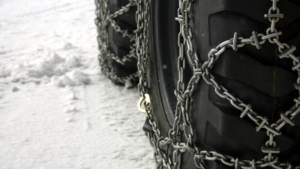
British Columbia takes a route-based approach instead of a province-wide one. Winter tires or chains are required on most designated highways from October 1 to April 30, with a shorter window of October 1 to March 31 on select routes that aren’t part of a through-route, mainly mountain passes. If your travels take you over the Coquihalla or other mountain highways, it’s worth checking the Government of British Columbia’s winter driving page for the routes that apply.
Winter Tire Laws in Canada: Ontario and the Rest of the Country
Ontario doesn’t require winter tires by law, but the province does require insurers to offer a discount to drivers who use them. The amount varies by insurer, and many companies ask that the tires be installed by a certain date, so it’s worth asking yours what they need from you. In most other provinces the decision is left to drivers, and local rules can differ, so a quick look at your provincial transportation ministry’s website is a good habit before the season starts.
Winter Tire Laws in the US: A State-by-State Picture
There’s no federal winter tire requirement in the US. Instead, states set their own rules, and they tend to focus on mountain roads and storm conditions. Colorado is a good example. During a period of traction law, passenger vehicles must have tires with at least 3/16″ of tread that are rated all-weather or winter (marked with the mountain-snowflake icon or M+S), or carry chains or an approved alternative traction device, and the laws can be enforced on I-70 between Morrison and Dotsero from September 1 to May 31, or whenever conditions require. Fines apply for non-compliance, and you can see the details on the Colorado Department of Transportation’s website. Colorado has also updated its requirements recently, so it’s worth checking the latest rules before you travel.
Many states also set dates for when studded tires are allowed, often running roughly from November through April, although the exact dates differ. If your route takes you through several states, checking each state’s department of transportation will give you the most accurate picture.
Beyond the Law: When Winter Tires Make Sense
Even in places where winter tires aren’t required, they tend to make a real difference once temperatures drop, since the rubber on all-season tires begins to stiffen around 7°C. Our post on when to switch to winter tires covers the timing in more detail, and our guide to the 7°C guideline explains the thinking behind it.
Meeting Winter Tire Laws in Canada From Your Own Driveway
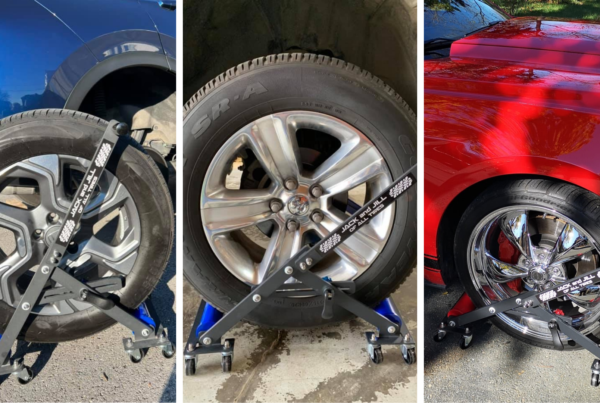
Whatever the requirement where you live, the swap itself can be a comfortable weekend project at home. Your floor jack takes care of the lifting, and the Jack and Jill of All Tires helps with the next part, supporting the weight of a 40 to 100 lb wheel so that you can guide it into place instead of holding it up. Our complete step-by-step guide walks through the process, and the tools page lists what to have on hand. Ready to make tire changing easy? Check out the Jack and Jill of All Tires here.